Meet the people your path actually crossed.
Passn turns the ordinary geography of your day — the tram, the gym, the café two streets over — into a reason to say hello. You see who crossed your path, roughly where and roughly when. You never see anyone's live location, and nobody sees yours.
The idea
Proximity is a better introduction than an algorithm.
Most dating apps drop you into an endless national grid of strangers. Passn starts smaller and more honest: the people who already move through the same streets you do. Shared geography is a real thing you have in common — a neighbourhood, a commute, a Tuesday evening habit — and it makes the first message easy to write.
Your paths cross
With your permission, Passn notices when you and another member were in roughly the same place at roughly the same time. Nothing precise is ever stored.
You decide who sees you
Crossings become profile cards — not a live map of people. Set your distance, age and visibility rules, or go invisible entirely and browse without appearing.
You talk when it is mutual
Nobody can message you until you both like each other. From there: text, photos, voice notes, GIFs, and audio or video calls that are never recorded.
What is inside
A complete app, not a swipe deck.
Crossings & map
A map of where paths met, blurred by design: what is stored is the midpoint between two people, moved by a random offset of up to 50 m — never anyone’s own position.
Today
A short, curated set of people each day instead of an infinite feed — with likes, super likes and undo.
Chat & calls
Text, images, voice notes and GIFs after a mutual match, plus one-to-one audio and video calls. Call media is peer-to-peer and never recorded.
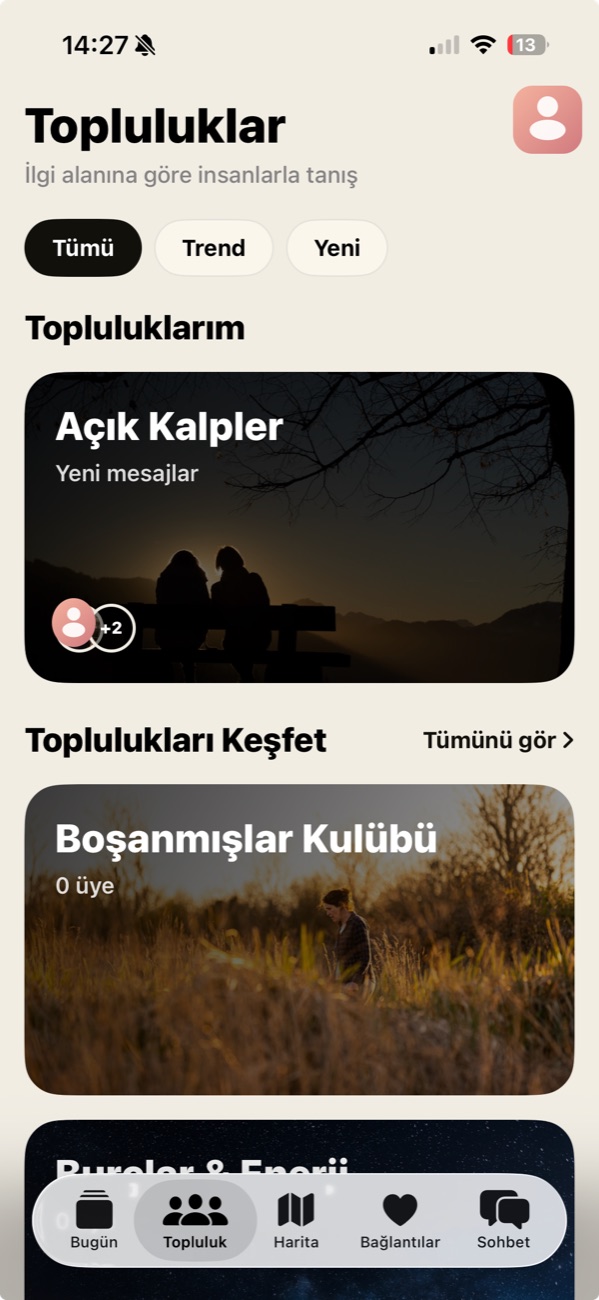
Communities
Topic rooms — coffee, running, film, new-in-town — where conversation starts before anybody has to match.
Verification
Optional face verification proves a profile belongs to a live human being, and earns a badge other members can see.
Control & deletion
Invisible mode, blocking, granular notification settings, and one-tap account deletion with a 14-day grace period.
Safety by construction
The safest thing we can do with your location is not store it.
Passn was designed so that the sensitive parts of a dating app are narrow by default. Precise coordinates are never persisted, never shown to another member, and never sold. Reports reach a human moderator with the conversation context attached, and blocking is enforced on the server — not just hidden in the interface.
±50 m
Random offset applied to every crossing before it is stored
18+
Enforced at sign-up and at the database layer
0
Third-party trackers and data brokers in the app
14 days
Grace period after you delete your account, then erasure
Details, retention periods and the legal basis for each category are set out in the Privacy Policy and the location disclosure.
Beyond matching
Rooms where the conversation starts first.
Communities are moderated group chats organised around ordinary interests. They exist because the hardest part of meeting people is rarely the match — it is having something to say. Stories and encounters do the same job from the other direction: light, low-stakes context about a person before you decide to reach out.
Conversation
Matched, then actually talking.
A match opens a normal, complete messenger: text, photos, voice notes, GIFs, read receipts you can control, and one-to-one audio and video calls. Calls run peer-to-peer through a real-time infrastructure provider; Passn does not record audio or video, and no recording is stored anywhere.
- Text, photos, voice notes and GIFs
- Audio and video calls with your matches
- Block and report from inside any thread
The company
Who is behind Passn.
Passn is built and operated by Passn LLC, a limited liability company registered in Delaware, United States on June 22, 2026 (file number 10669152). We are a small, independent team; the product is funded by subscriptions rather than advertising, which is why there are no ad networks or data brokers anywhere in the stack.
Independent
No outside advertising business, no data resale. Revenue comes from Passn Plus subscriptions bought through the App Store.
Documented
Privacy, terms, community rules, child-safety standards, location handling and deletion are all published in full before launch.
Reachable
Written support at support@passn.app, with dedicated channels for privacy, safety and security reports.
Questions
Straight answers.
More in the support centre, or write to us directly — a person answers.